
This article explains how a single drone spray lance covers two different cleaning jobs — solar panels and building facades — on one airframe. The WasherDrone SkyLance M400 is a drone spray lance built specifically for the DJI Matrice 400, the heavy-lift platform that washing drone operators on five continents have standardised on. WasherDrone supplies the lance as equipment; the operator performs the work. What follows covers the two spray geometries, the difference between a softwash and a pressure-wash working point, the payload arithmetic that sets your reach, and how the kit is ordered.
What a Drone Spray Lance Does on the DJI Matrice 400
A drone spray lance is defined as a rigid, drone-mounted delivery arm that carries pressurised water from a ground pump to a nozzle at working height, holds that nozzle clear of the airframe, and directs the jet at the target surface.
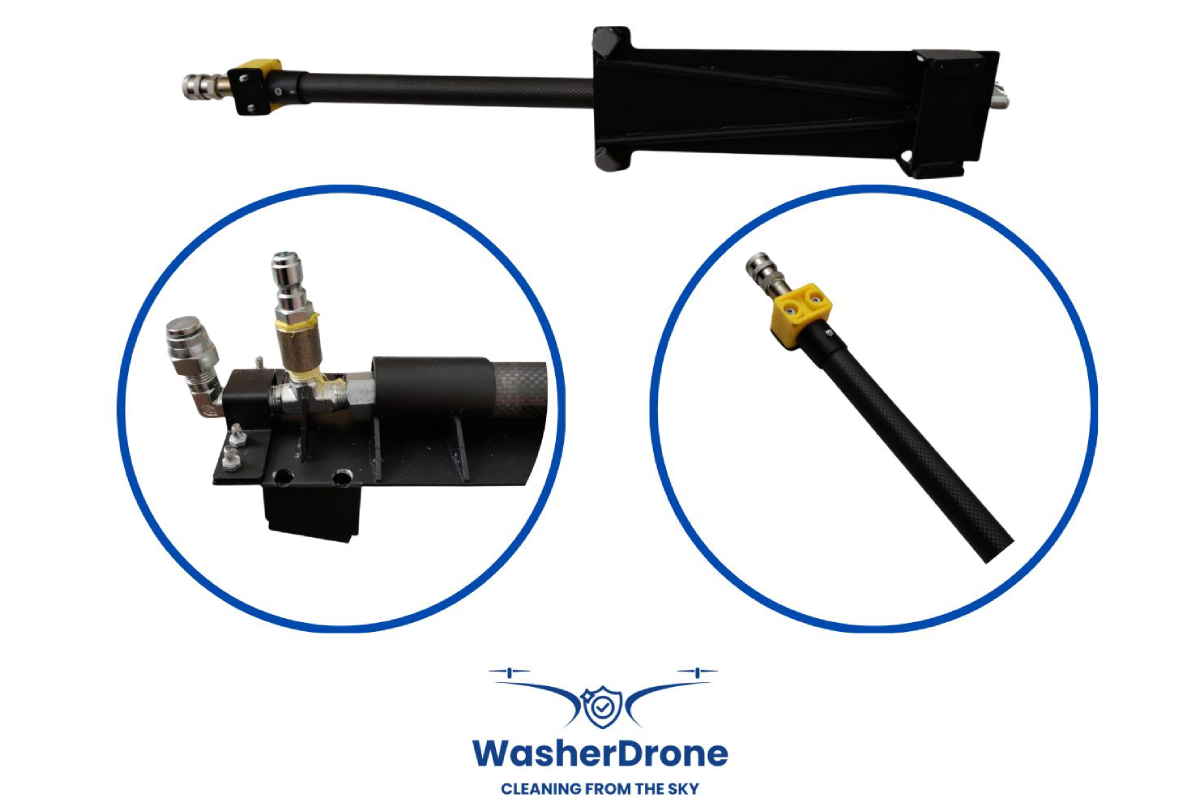
The drone does not do the work. The drone carries the nozzle to height; the ground system does the work. That division is what keeps the airborne part light: the SkyLance M400 is a carbon-fibre body of approximately 1 kg (2.2 lb) including its retention lanyard, with no electrical or electronic content whatsoever.
- Plug-and-play mount. Designed for the DJI Matrice 400 airframe — no custom wiring or adaptation.
- Quick-connect feed. High-pressure water enters through a coupling on the base manifold.
- EMI-shielded body. Built to limit interference with the aircraft’s flight systems.
- Steel wire-rope lanyard. Links the supply hose to the lance so a detached hose stays with the aircraft.
One Lance, Two Geometries: Solar Panels and Facades
The key difference between solar panel cleaning and facade cleaning is the direction of attack: panels are washed vertically downward onto a near-horizontal plane, while facades are washed horizontally forward onto a vertical plane.
Most operators solve this with two separate tools. The SkyLance M400 solves it with one, through an interchangeable nozzle system that includes a dedicated solar panel nozzle on the rear manifold. The aircraft hovers above an array and sprays down; the same aircraft holds station off a wall and sprays forward. For operators building a mixed portfolio across building cleaning with drones and solar panel cleaning, that is one kit to buy, transport and maintain instead of two.
Softwash or Pressure Wash: Setting the Working Point
The key difference between softwash and pressure washing is which variable does the cleaning: softwash relies on water volume and chemical dwell time at moderate pressure, while pressure washing relies on concentrated jet energy at high pressure and lower volume.
The SkyLance M400 is rated for both ends of that range — up to 300 bar (4,351 psi) for pressure-wash work, or up to 30 L/min (7.9 US gal/min) for softwash work. These two maxima are not simultaneous. The nozzle sets the working point, and the ground pump configuration has to match it.
The practical ceiling is not the lance, it is the aircraft. Jet reaction force rises with both pressure and flow, and the usable working point is bounded by the drone’s ability to hold position against that force. Operators sizing a configuration before purchase can work this through with the WasherDrone drone nozzle calculator.
Weight, Reach and the Payload Ceiling
Working height on a tethered drone cleaning system is set by payload capacity, not by hose length alone, because the suspended weight of the water-filled supply hose grows as the aircraft climbs.
The arithmetic is simple: maximum suspended hose = (drone payload capacity − airborne kit mass) ÷ water-filled hose mass per metre.
According to DJI’s published specifications for the Matrice 400, the airframe carries a maximum payload of 6.2 kg (13.7 lb). With an airborne kit mass of roughly 1 kg (2.2 lb) and a water-filled hose at 0.1 kg/m (0.067 lb/ft), that yields approximately 52 m (171 ft) of suspended hose. The governing limit is whichever is lower — that figure or the actual hose length on the reel. Verify all three inputs against your own configuration.
SkyLance M400 Specifications
The table below lists the published figures for the SkyLance M400 kit in both metric and US customary units.
| Parameter | Metric | Imperial (US) |
|---|---|---|
| Compatibility | DJI Matrice 400 | DJI Matrice 400 |
| Weight (incl. lanyard) | ~1 kg | ~2.2 lb |
| Package dimensions (L×W×H) | 800 × 160 × 80 mm | 31.5 × 6.3 × 3.1 in |
| Max. working pressure | 300 bar | 4,351 psi |
| Burst pressure (safety rating) | 800 bar | 11,603 psi |
| Max. flow rate | 30 L/min | 7.9 US gal/min |
| Aircraft max. payload (DJI M400) | 6.2 kg | 13.7 lb |
| Water-filled hose mass | 0.1 kg/m | 0.067 lb/ft |
| Indicative suspended hose limit | ~52 m | ~171 ft |
| Electrical content | None | None |
How Operators Order the SkyLance M400 Drone Spray Lance
The SkyLance M400 is ordered as a stocked kit rather than as a quoted system, which is what separates it from a full ground-unit purchase: the operator orders the drone spray lance directly and receives it within about a week.
The kit ships with the lance, the steel hose-retention lanyard, mounting components and installation accessories. It is available through the SkyLance M400 product page, alongside the rest of the air platform category.
Three things are deliberately not in the box: the DJI Matrice 400 airframe, the SkyHose supply hose, and the ground pump unit. Shipping and customs duties are excluded.
Frequently Asked Questions
Can one drone spray lance clean both solar panels and building facades?
Yes. The SkyLance M400 uses an interchangeable nozzle system, including a dedicated solar panel nozzle on the rear manifold for downward vertical spray, and a forward-facing configuration for horizontal facade work. The same lance and the same aircraft cover both surface types, so an operator does not need to carry two separate airborne kits.
Does the SkyLance M400 deliver 300 bar and 30 L/min at the same time?
No. The lance is rated for up to 300 bar (4,351 psi) and for up to 30 L/min (7.9 US gal/min), but not for both simultaneously. The installed nozzle and the ground pump configuration determine which point on that envelope the system operates at. Jet reaction force rises with both variables, and the aircraft’s ability to hold position is the real constraint.
Will the lance fit drones other than the DJI Matrice 400?
The SkyLance M400 is a purpose-built mount for the DJI Matrice 400 airframe and is not a universal fitting. The airframe is required and sold separately. Operators flying other platforms should contact WasherDrone to discuss the appropriate lance variant.
What else does an operator need to start washing?
Beyond the lance and the airframe, an operation needs a high-pressure supply hose, a ground pump unit sized to the intended working point, and — in the EASA Specific category — an operational authorisation issued to the operator by the national aviation authority. The lance is equipment, not an authorisation, but its documented hose retention, pressure-loss shutdown behaviour and passive reach limits give an operator engineering evidence to reference when building that case.
Written by the WasherDrone engineering and content team. WasherDrone designs and manufactures drone-based exterior cleaning systems in Türkiye and supplies them to operators worldwide; WasherDrone does not perform cleaning services commercially. The figures in this article are drawn from WasherDrone product documentation and from DJI’s published Matrice 400 specifications. For configuration questions about the SkyLance M400 drone spray lance, or for sizing a ground unit to match it, contact the WasherDrone technical team.