
Par l'équipe technique de WasherDrone Ingénierie des systèmes de nettoyage par drones
Choisir le bon tuyau pour les systèmes de nettoyage par drone est l'une des décisions d'ingénierie les plus importantes – et les plus sous-estimées – dans les opérations professionnelles de nettoyage de façades. Un tuyau inadapté ne se contente pas de réduire les performances de nettoyage ; il consomme la charge utile qui devrait être allouée au pistolet de nettoyage, déstabilise le drone en vol, accélère l'usure du matériel et augmente le coût total de possession sur toute la durée de vie du système.
Cet article explique précisément comment choisir le tuyau adapté aux systèmes de nettoyage par drone en fonction de trois variables : la pression nominale, le débit et le poids total du tuyau, y compris la colonne d’eau à l’intérieur du tuyau pendant son fonctionnement.
Pourquoi le choix du tuyau est une décision cruciale pour le bon déroulement d'un vol de nettoyage par drone
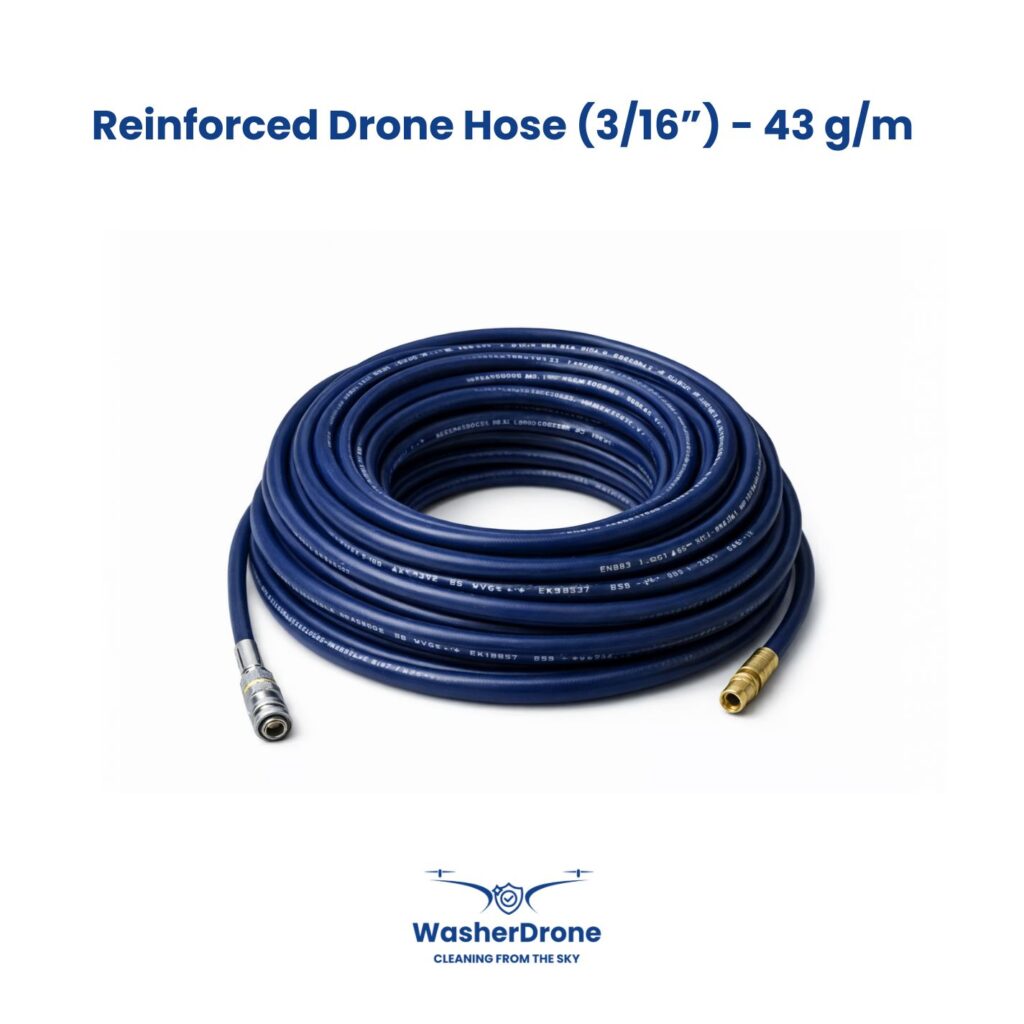
Dans un système de nettoyage par drone, le tuyau n'est pas un simple conduit passif ; c'est un composant essentiel au vol qui influe directement sur la stabilité du drone, la marge de charge utile et le rendement du nettoyage.
Dans le nettoyage haute pression au sol, le choix du tuyau est secondaire. Les opérateurs privilégient la pression nominale et la praticité ; le poids est sans importance. En revanche, dans les systèmes de nettoyage par drone, le poids est un facteur déterminant pour chaque composant. Chaque mètre de tuyau suspendu au drone ajoute deux charges distinctes : la masse du tuyau lui-même et celle de la colonne d'eau qu'il contient. À une hauteur opérationnelle de 30 mètres, ces charges s'accumulent rapidement et consomment une part importante de la charge utile, qui ne peut être récupérée.
Parallèlement, un tuyau dont le diamètre intérieur est trop étroit pour le débit visé engendre un autre problème : une vitesse d’écoulement excessive. L’eau propulsée à travers un diamètre inférieur à un débit élevé provoque une érosion interne, une perte de pression le long du tuyau et des turbulences au niveau de la buse, autant de facteurs qui réduisent directement l’efficacité du nettoyage par heure de vol.
Le tuyau idéal pour un système de nettoyage de drone est celui qui remplit simultanément ces trois conditions : il doit être adapté à la pression de service, correspondre au débit cible et être suffisamment léger pour rester dans l'encombrement de la charge utile du drone.
Les trois variables qui déterminent le choix des tuyaux pour les systèmes de nettoyage de drones
1. Pression nominale (bar / PSI)
La pression nominale correspond à la pression de service maximale qu'un tuyau est certifié pouvoir supporter en continu sans dégradation structurelle. Pour les systèmes de nettoyage par drone, la pression de service est déterminée par la pompe au sol — généralement entre 100 et 350 bars (1 450 à 5 076 psi) selon l'application de nettoyage et le type de surface.
La pression nominale du tuyau doit être égale ou supérieure au débit de la pompe. Un avantage crucial, propre aux opérations de nettoyage par drone, réside dans la chute de pression naturelle avec l'altitude : la pression de l'eau diminue d'environ 1 bar (14,5 psi) tous les 10 mètres (32,8 pieds) de hauteur verticale. À 30 mètres (98,4 pieds), la pression effective à la buse est déjà inférieure de 3 bars (43,5 psi) au débit de la pompe. Cette marge de sécurité liée à l'altitude signifie qu'un tuyau dimensionné exactement pour la pression de la pompe offre une marge de sécurité intégrée lors des opérations en altitude ; un coefficient de sécurité supplémentaire de 1,5 n'est donc pas nécessaire. Pour en savoir plus… Système au sol WashingDrone SkyBase Pour connaître les spécifications de la pompe, consultez notre analyse complète du système.
À titre de référence : 1 bar = 14,5 psi. Une pompe fonctionnant à 200 bars fournit environ 2 900 psi au niveau du sol.
2. Débit (LPM / GPM)
Le débit correspond au volume d'eau distribué à la buse par minute. Dans les systèmes de nettoyage par drone, le débit détermine l'intensité du nettoyage et la vitesse de couverture des surfaces. Il est exprimé en litres par minute (LPM) ou en gallons par minute (GPM) ; 1 LPM = 0,264 GPM.
La relation entre le débit et le diamètre intérieur est déterminée par la vitesse d'écoulement, c'est-à-dire la vitesse à laquelle l'eau circule dans le tuyau. La vitesse d'écoulement est la variable d'ingénierie critique, et non le débit seul. Les limites de fonctionnement recommandées pour les tuyaux de nettoyage de drones sont les suivantes :
| Vitesse d'écoulement | Statut |
|---|---|
| Moins de 4 m/s (13,1 pi/s) | Idéal |
| 4–6 m/s (13,1–19,7 pi/s) | Acceptable |
| Au-dessus de 6 m/s (19,7 pi/s) | Problématique — l'érosion interne s'accélère |
3. Poids total du tuyau : Matériau du tuyau + Colonne d'eau
Le poids total du tuyau correspond à la masse combinée par mètre du matériau du tuyau et de la colonne d'eau qu'il contient en fonctionnement. C'est une variable que la plupart des opérateurs sous-estiment lors de la configuration d'un système de nettoyage par drone.
Le poids de l'eau par mètre est entièrement déterminé par le diamètre intérieur :
| diamètre intérieur | Poids de l'eau par mètre |
|---|---|
| 3/16″ (4,76 mm) | 17,8 g/m (0,63 oz/ft) |
| 1/4″ (6,35 mm) | 31,7 g/m (1,12 oz/ft) |
| 5/16″ (7,94 mm) | 49,5 g/m (1,75 oz/pi) |
| 3/8″ (9,52 mm) | 71,3 g/m (2,52 oz/pi) |
Avec une longueur de tuyau de 30 m (98,4 pi) et un diamètre de 9,52 mm (3/8 po), la colonne d'eau à elle seule pèse plus de 2 kg (4,4 lb), sans compter le poids du tuyau lui-même. Pour les opérateurs dont la charge utile est limitée, ce chiffre représente la contrainte principale pour le choix du diamètre du tuyau.
Tableau de référence des tuyaux : pression, débit et poids pour le nettoyage par drone
Le tableau ci-dessous présente les configurations de tuyaux thermoplastiques utilisées dans les systèmes de nettoyage professionnels par drone. Les produits WasherDrone SkyHose sont identifiés par leur nom ; les lignes suivantes servent de référence technique pour les opérateurs concevant des configurations personnalisées.
Types de construction :
- tresse en polyester — Renfort textile simple ou double couche ; plus léger pour les applications sous pression standard
- tresse d'aramide — Renforcement en fibres synthétiques haute résistance ; résistance à la pression supérieure par unité de poids ; idéal pour les configurations de nettoyage de drones exigeantes
| Produit | Faible | Construction | Pression maximale (bar) | Pression maximale (psi) | Débit maximal (LPM) | Débit maximal (GPM) | Tuyau (g/m) | Eau (g/m) | Total (g/m) | Diamètre intérieur (mm) | Ø extérieur (mm) |
| — | 1/4″ | tresse en polyester | 137 | 1,987 | 11.4 | 3.0 | 76 | 31.7 | 107.7 | 6.35 | 11.4 |
| SkyHose 5 | 1/4″ | tresse en polyester | 200 | 2,901 | 11.4 | 3.0 | 89 | 31.7 | 120.7 | 6.35 | 11.8 |
| — | 1/4″ | tresse en polyester | 225 | 3,263 | 11.4 | 3.0 | 82 | 31.7 | 113.7 | 6.35 | 11.4 |
| — | 1/4″ | Tresse en aramide (R8) | 345 | 5,004 | 11.4 | 3.0 | 91 | 31.7 | 122.7 | 6.35 | 11.5 |
| SkyHose 6 | 1/4″ | tresse en polyester (double) | 200 | 2,901 | 11.4 | 3.0 | 89 | 31.7 | 120.7 | 6.35 | 11.8 |
| — | 5/16″ | tresse en polyester | 137 | 1,987 | 17.8 | 4.7 | 109 | 49.5 | 158.5 | 7.94 | 13.0 |
| — | 5/16″ | tresse en polyester (double) | 190 | 2,756 | 17.8 | 4.7 | 121 | 49.5 | 170.5 | 7.94 | 14.0 |
| SkyHose 8 | 5/16″ | tresse d'aramide | 200 | 2,901 | 17.8 | 4.7 | 92 | 49.5 | 141.5 | 7.94 | 13.0 |
| — | 5/16″ | Tresse en aramide (R8) | 300 | 4,351 | 17.8 | 4.7 | 137 | 49.5 | 166.5 | 7.94 | 12.5 |
| — | 3/8″ | tresse en polyester | 137 | 1,987 | 25.7 | 6.8 | 117 | 71.3 | 208.3 | 9.52 | 15.5 |
| — | 3/8″ | tresse en polyester (double) | 175 | 2,538 | 25.7 | 6.8 | 154 | 71.3 | 225.3 | 9.52 | 16.2 |
| SkyHose 10 | 3/8″ | tresse d'aramide | 190 | 2,756 | 25.7 | 6.8 | 102 | 71.3 | 173.3 | 9.52 | 15.0 |
| — | 3/8″ | Tresse en aramide (R8) | 275 | 3,988 | 25.7 | 6.8 | 144 | 71.3 | 215.3 | 9.52 | 15.5 |
Les valeurs de débit maximal sont calculées à une vitesse d'écoulement maximale de 6 m/s (19,7 pi/s) — la limite opérationnelle supérieure pour les applications professionnelles de nettoyage de tuyaux de drones.
Pourquoi la tresse en aramide surpasse le polyester dans les applications de tuyaux de nettoyage de drones
La construction en tresse d'aramide offre un rapport pression/poids supérieur à celui du polyester pour tous les diamètres intérieurs de la gamme de nettoyage des drones.
La principale différence entre les tuyaux tressés en aramide et en polyester ne réside pas dans le prix, mais dans les propriétés mécaniques de la fibre de renforcement. L'aramide (la même fibre que celle utilisée pour la protection balistique et les applications aérospatiales) offre une résistance à la traction supérieure à poids égal à celle du polyester. Dans la fabrication des tuyaux, cela se traduit directement par une pression nominale plus élevée pour une paroi plus légère.
Avec un diamètre intérieur de 7,94 mm (5/16″), la tresse aramide SkyHose 8 pèse 92 g/m (0,51 oz/pi) et supporte une pression de 200 bar (2 901 psi). Son équivalent en polyester double couche, de même diamètre, pèse 121 g/m (0,67 oz/pi) et supporte une pression de seulement 190 bar (2 756 psi). La construction en aramide est donc simultanément plus légère et supporte une pression plus élevée.
Pour les configurations de systèmes de nettoyage par drone où le budget de charge utile est limité et les exigences de pression non négociables, le renforcement en aramide est le choix techniquement correct — et non une option de mise à niveau.
Chute de pression due à l'altitude : un tampon naturel dans les systèmes de nettoyage par drones
L'un des avantages techniques propres aux systèmes de nettoyage par drone par rapport au lavage à haute pression au sol est l'atténuation naturelle de la pression avec l'altitude.
La pression de l'eau diminue d'environ 1 bar (14,5 psi) tous les 10 m de hauteur. À 30 m d'altitude opérationnelle — hauteur de travail standard pour le nettoyage des façades —, la pression effective à la buse est inférieure de 3 bars (43,5 psi) au débit nominal de la pompe. À 50 m, la réduction atteint 5 bars (72,5 psi).
Cela a deux conséquences pratiques pour le choix des tuyaux dans les systèmes de nettoyage par drone. Premièrement, le tuyau n'atteint jamais le débit nominal maximal de la pompe à l'altitude de fonctionnement ; la marge de sécurité liée à l'altitude est intrinsèque. Deuxièmement, à cette altitude, la perte de charge le long du tuyau due aux frottements de l'écoulement devient le principal facteur d'ingénierie, et non la pression nominale absolue. Ceci souligne l'importance de maîtriser la vitesse d'écoulement dans la plage de fonctionnement de 4 à 6 m/s (13,1 à 19,7 pi/s).
Que se passe-t-il lorsque vous dépassez la limite de vitesse d'écoulement ?
Une vitesse d'écoulement supérieure à 6 m/s (19,7 pi/s) dans un tuyau de nettoyage de drone produit trois effets de défaillance cumulatifs.
Érosion interne L'usure s'accélère au carré de la vitesse. Si le débit double, le taux d'usure est multiplié par quatre. La dégradation se produit de l'intérieur de la paroi du tuyau sans signes extérieurs visibles, jusqu'à la rupture.
perte de pression La pression exercée sur le tuyau augmente avec la vitesse. Une part importante du débit nominal de la pompe est absorbée par le frottement au lieu d'être délivrée sous forme de pression de nettoyage à la buse. L'opérateur paie donc pour une capacité de pompe qui n'atteint pas la façade.
Jet turbulent Cela réduit la force d'impact par unité de surface. Lors des opérations de nettoyage par drone, les turbulences génèrent également des impulsions de pression dans le tuyau, qui se transmettent sous forme de vibrations à la structure du drone, affectant ainsi la stabilité en vol et la précision des capteurs embarqués.
La réponse appropriée à une exigence de débit qui dépasse la limite de vitesse pour un diamètre donné consiste à passer au diamètre supérieur — en acceptant le poids supplémentaire — et à tenir compte de ce poids dans le calcul de la charge utile du drone avant le déploiement du système.
FAQ : Tuyau pour systèmes de nettoyage de drones
Quel est le diamètre maximal recommandé pour les tuyaux des systèmes de nettoyage par drones ?
Le diamètre intérieur maximal utilisable pour les tuyaux de nettoyage de drones est de 9,52 mm (3/8″). Au-delà de cette dimension, le poids total du tuyau par mètre (matériau et colonne d'eau) dépasse 170 g/m (0,95 oz/pi), même pour les tuyaux en aramide les plus légers, ce qui est incompatible avec les contraintes de charge utile de la plupart des drones de nettoyage professionnels.
Pourquoi la vitesse d'écoulement est-elle plus importante que le débit lors du choix d'un tuyau de nettoyage pour drone ?
Le débit indique la quantité d'eau atteignant la buse par minute. La vitesse d'écoulement indique la rapidité avec laquelle cette eau se déplace dans le tuyau. Une vitesse supérieure à 6 m/s (19,7 pi/s) provoque une érosion interne, une perte de pression due au frottement et des turbulences dans la pulvérisation, indépendamment du débit. Deux tuyaux ayant un débit identique mais un diamètre intérieur différent présenteront des vitesses d'écoulement très différentes, et donc des résultats d'utilisation très différents.
L'altitude de fonctionnement influe-t-elle sur les exigences de pression des tuyaux lors du nettoyage par drone ?
Oui. La pression de l'eau diminue d'environ 1 bar (14,5 psi) par tranche de 10 m (32,8 pi) de hauteur. À une altitude de travail standard de 30 m (98,4 pi), le tuyau subit une pression inférieure de 3 bars (43,5 psi) au débit nominal de la pompe au sol. Cette réduction naturelle de pression offre une marge de sécurité intrinsèque et signifie que, dans les configurations spécifiques aux drones, un tuyau dimensionné à la pression de sortie de la pompe présente déjà une marge opérationnelle significative.
Cet article a été rédigé par l'équipe technique de WasherDrone. WasherDrone conçoit et fournit des systèmes de nettoyage de façades par drones destinés aux professionnels. Toutes les spécifications des tuyaux mentionnées dans cet article proviennent de la documentation technique du tuyau SkyHose de WasherDrone.
Pour obtenir des conseils sur la configuration de votre pompe, de votre tuyau et de votre buse, contactez l'équipe technique de WasherDrone pour une analyse de la configuration de votre système.
Pour un contexte plus large sur les applications des systèmes de nettoyage par drones, voir Nettoyage de bâtiments par drones et le Système de nettoyage par drone WasherDrone.