
This article explains how to configure nozzles for drone pressure washing systems across every common facade cleaning scenario. Correct drone pressure washing nozzle configuration determines whether a surface is cleaned efficiently, damaged, or left with residue — and it is one of the most consequential decisions an operator makes before takeoff.
Whether you are running your first job or expanding to new surface types, this guide covers the full decision chain: nozzle type selection, hose compatibility, pressure range, dual nozzle rules, and hot water usage.
Drone pressure washing nozzle configuration is defined as the complete selection of nozzle type, orifice size, spray angle, hose diameter, operating pressure, and chemical injection mode matched to a specific surface and contamination type.
A mismatch at any point in this chain produces one of three failure modes: insufficient cleaning impact (too wide an angle or too low a pressure), surface damage (too concentrated a jet on a delicate substrate), or back-pressure overload on the drone pump (nozzle orifice too small for the hose and flow rate combination).
The key difference between drone nozzle configuration and ground-based configuration is standoff distance. A drone operates at 0.5–2 m (1.6–6.6 ft) from the facade, which means the jet geometry at the nozzle exit directly determines coverage width, impact force, and drift. Decisions that seem minor on the ground — a 15° vs 25° fan angle, a C30 vs C35 turbo capacity — become critical at altitude.
The WasherDrone Nozzle Family: Four Types, One Decision Framework
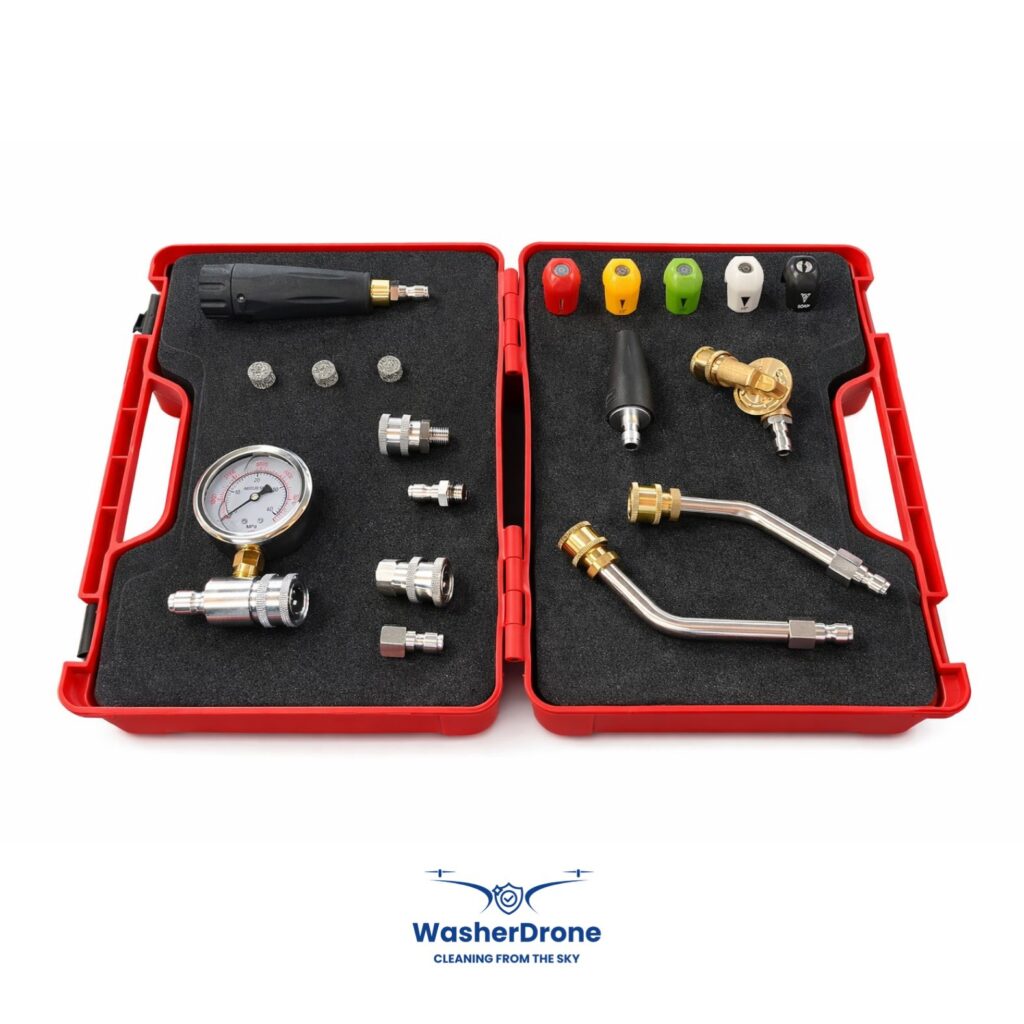
WasherDrone supplies four nozzle types as part of its peripheral product line. Each is engineered for a distinct role. For a full analysis of how to choose between nozzle types before purchase, see our guide on how to select the right nozzle for drone pressure washing.
| Nozzle | Type | Pressure Range | Primary Role |
|---|---|---|---|
| Jet Nozzle Pack | Fan jet — 0°, 15°, 25°, 40° | 100–200 bar (1,450–2,900 psi) | Precision cleaning; multi-angle versatility |
| Sweeping Turbo Nozzle | Oscillating jet, 30° sweep | 60–200 bar (870–2,900 psi) | Wide coverage; stone, metal, concrete |
| Rotary Turbo Nozzle | Rotating jet, 22° cone | 52–200 bar (754–2,900 psi) | Solar panels; delicate or uniform surfaces |
| Jet Foam Nozzle | Chemical injection | Full range | Pre-treatment; always paired with cleaning nozzle |
The Sweeping Turbo Nozzle is the de facto standard for most facade scenarios. The Jet Nozzle Pack provides surgical precision for joints, edges, and complex geometry. The Rotary Turbo Nozzle is the mandatory choice for solar panels. The Jet Foam Nozzle is always paired with a second cleaning nozzle — it does not clean alone.
Hose-to-Nozzle Compatibility: The Rule That Governs Every Configuration
Hose-to-nozzle compatibility is the constraint that overrides all other configuration preferences. Selecting the wrong hose for a given nozzle creates back-pressure that stresses the pump, reduces cleaning performance, and shortens component life. For a full breakdown of SkyHose specifications, see our guide on how to choose the right hose for drone cleaning systems.
| Hose | Inner Diameter | Max Flow Rate | Compatible Nozzles |
|---|---|---|---|
| SkyHose 5/6 | 1/4 in (6 mm) | 11.4 L/min (3.0 GPM) | Jet Nozzle Pack 3.0 (full range); Sweeping Turbo C30 (max 100 bar / 1,450 psi); Rotary Turbo 3.0 (caution at 200 bar / 2,900 psi); Jet Foam |
| SkyHose 8 | 5/16 in (8 mm) | 17.8 L/min (4.7 GPM) | All nozzles — full pressure range. Field standard. Mandatory for dual nozzle. |
| SkyHose 10 | 3/8 in (10 mm) | 25.7 L/min (6.8 GPM) | All nozzles — full pressure range. Maximum capacity deployments. |
The operative rule: SkyHose 8 is the field standard. It accommodates every nozzle type across the full pressure range and is mandatory for all dual nozzle configurations without exception. SkyHose 5/6 is suitable for single-nozzle, lower-pressure work on light soiling. SkyHose 10 is reserved for maximum-capacity deployments.
Application Matrix: Matching Drone Pressure Washing Nozzle Configuration to Surface Type
The table below defines the recommended drone pressure washing nozzle configuration for each surface type encountered in drone-based facade cleaning operations. These combinations are derived from WasherDrone’s operational testing data.
| Surface | Nozzle | Count | Hose | Pressure | Chemical | Hot Water |
| Glass facade | Sweeping Turbo C30 | 1 | SkyHose 8 | 100–150 bar (1,450–2,175 psi) | Optional | Optional max 90°C (194°F) |
| Aluminium composite | Jet Nozzle Pack 3.0 | 1 | SkyHose 5/6 | 100–130 bar (1,450–1,885 psi) | No | Optional max 60°C (140°F) |
| Ceramic / coated | Jet Nozzle Pack 3.0 | 1 | SkyHose 5/6 | 100–150 bar (1,450–2,175 psi) | Optional | Optional |
| Stone / concrete | Sweeping Turbo C30 | 1 | SkyHose 8 | 150–200 bar (2,175–2,900 psi) | Yes | Yes — 90°C (194°F) |
| Construction dust | Sweeping Turbo C30–C35 | 1 | SkyHose 8 | 150–200 bar (2,175–2,900 psi) | Yes | Yes |
| Metal facade | Sweeping Turbo C30 | 1 | SkyHose 8 | 150–200 bar (2,175–2,900 psi) | Yes | Yes — 90°C (194°F) |
| Solar panels | Rotary Turbo 3.0 | 2 | SkyHose 8 | 60–80 bar (870–1,160 psi) | No | PROHIBITED |
| Large flat facade | Jet Nozzle Pack 3.0 | 2 | SkyHose 8 | 100–150 bar (1,450–2,175 psi) | Optional | Optional |
| Chemical + rinse | Jet Foam + Jet Nozzle Pack 3.0 | 2 | SkyHose 8 | 100–150 bar (1,450–2,175 psi) | Yes | Optional |
Shop WasherDrone Nozzles & Peripherals →
Fan Angle Selection for the Jet Nozzle Pack
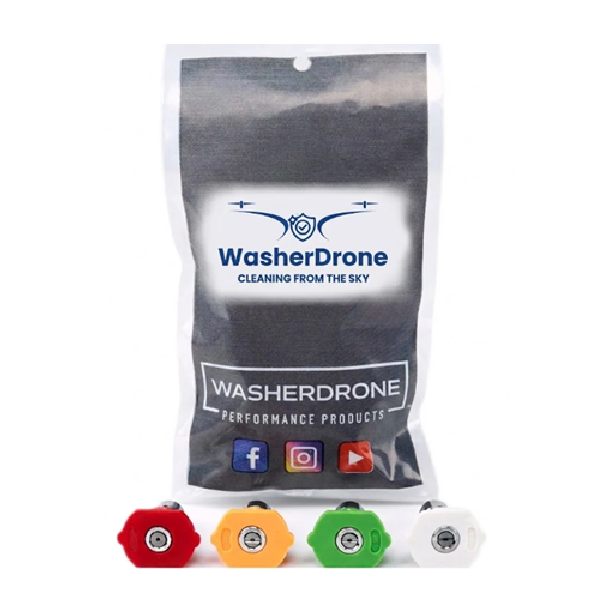
Fan angle selection for the Jet Nozzle Pack determines impact concentration versus surface coverage. This is not a preference decision — it follows a fixed sequence based on soiling type and geometry.
- Localised hard soiling — joints, corners, recesses: 0° point nozzle. Use as a pre-pass. Follow with 25° or 40° for the main wash.
- Wind conditions or extended standoff distance: 15°. Maintains impact at greater distances.
- Standard soiling, standard standoff: 25°. Default for most scenarios.
- Light soiling, close standoff, large flat surface, or rinse pass: 40°. Maximum coverage width, minimum impact concentration.
The 0° nozzle is never used as a standalone cleaning pass on open surfaces. It is a precision instrument for confined soiling, used before the primary nozzle covers the zone. This applies equally to every pressure washing nozzle angle selection decision on the drone — the goal is always minimising standoff loss while protecting the substrate.
Dual Nozzle Drone Washing Setup: When and How to Run Two Nozzles
A dual nozzle drone washing setup increases coverage rate and enables two-stage cleaning within a single flight. It is not universally appropriate.
When Dual Nozzle Is Recommended
- Solar panel arrays: 2× Rotary Turbo Nozzle 3.0 — maximises panel coverage per pass
- Large flat facades: 2× Jet Nozzle Pack 3.0 — parallel jets reduce total flight time
- Chemical plus rinse jobs: Jet Foam Nozzle + Jet Nozzle Pack 3.0 — sequential application in one deployment
When Dual Nozzle Is Not Appropriate
- Narrow or geometrically complex surfaces
- Corner and joint detail cleaning
- Any scenario where jet interference between the two nozzles would degrade impact precision
Non-negotiable rule: all dual nozzle configurations require SkyHose 8. The combined flow demand of two nozzles exceeds SkyHose 5/6 capacity in every case. Running dual nozzles on an undersized hose will generate back-pressure sufficient to damage the pump.
Hot Water Rules: Which Surfaces Permit It and Which Do Not
Hot water materially improves cleaning performance on biological soiling, grease films, and mineral deposits. It is not universally permitted.
- Solar panels: prohibited. Thermal shock risk. A cold panel hit with water above 60°C (140°F) risks micro-crack formation in the photovoltaic substrate. Always use ambient-temperature water.
- Aluminium composite: use with caution. Maximum 60°C (140°F) recommended. Higher temperatures risk adhesive layer delamination on older panels.
- Stone, concrete, metal: highly effective at 90°C (194°F). Recommended for biological contamination (algae, moss), hydrocarbon films, and traffic grime.
- Glass facades: operator discretion. Surface age, coating type, and joint material determine whether hot water is appropriate. When in doubt, test on an inconspicuous zone.
FAQ: Drone Pressure Washing Nozzle Configuration
Which nozzle should I use if I am just starting out and want a single configuration that works on most jobs?
The Sweeping Turbo Nozzle C30 on SkyHose 8 at 100–150 bar (1,450–2,175 psi) covers the largest range of common facade scenarios — glass, stone, metal, and construction dust — with a single setup. It is the starting point WasherDrone recommends for operators building their first kit.
Can I use SkyHose 5/6 for a dual nozzle configuration if I keep the pressure low?
No. SkyHose 5/6 has a maximum flow rate of 11.4 L/min (3.0 GPM), which is insufficient to supply two nozzles simultaneously at any useful operating pressure. SkyHose 8 is mandatory for all dual nozzle setups without exception.
What is the difference between the Sweeping Turbo Nozzle C30 and C35 in practice?
The C35 has a larger orifice capacity and is designed for high-flow, high-pressure coverage on wide flat surfaces. It requires SkyHose 8 and a minimum of 150 bar (2,175 psi) to operate correctly. The C30 is the default — switch to C35 only when surface area, speed, and pressure all point to the higher-capacity option simultaneously.
Why can I not use hot water on solar panels?
Solar panels are engineered to tight thermal tolerances. Rapid temperature differential between the panel surface and pressurised hot water can cause micro-fracturing in the photovoltaic cells, reducing panel efficiency over time. Cold or ambient-temperature water is the only safe option for solar panel cleaning.
This guide is produced by the WasherDrone technical team. WasherDrone designs and supplies drone-based pressure washing systems and peripheral components — including the nozzle configurations described in this article — to operators delivering professional facade cleaning services. For nozzle products and system peripherals, visit shop.washerdrone.com.